
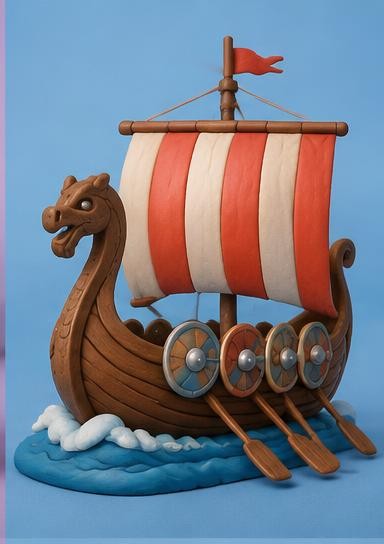
The Vikings
Leave the horned helmet behind. Trade, travel and powerful stones. Twelve questions, with a few convincing wrong turns along the way.
Free to use with your own team, courtesy of WorkplaceHero - workplacehero.co.uk
Question sheet
- 1. What is absent from the surviving Gjermundbu Viking helmet?
- A. Nose guard
- B. Iron construction
- C. Eye protection
- D. Horns
- 2. Which community suffered the famous Viking attack of 793 CE?
- A. Lindisfarne
- B. Canterbury
- C. Iona
- D. Glastonbury
- 3. Why is calling Lindisfarne in 793 the first recorded Viking attack in England misleading?
- A. It was in Wales
- B. An earlier Wessex encounter is recorded
- C. It happened in 893
- D. It was a Frankish army
- 4. What helped Viking warships travel upriver and land on beaches?
- A. Deep keels
- B. Stone ballast towers
- C. Shallow draught
- D. Multiple enclosed decks
- 5. Which trading centre lies in present-day Germany?
- A. Birka
- B. Ribe
- C. Kaupang
- D. Hedeby
- 6. What do Arabic silver coins found in Scandinavia chiefly demonstrate?
- A. Far-reaching exchange networks
- B. One Scandinavian currency
- C. No local metalworking
- D. Universal conversion to Islam
- 7. Who commissioned the large Jelling rune stone around 965 CE?
- A. Cnut the Great
- B. Harald Bluetooth
- C. Harald Hardrada
- D. Sweyn Forkbeard
- 8. What religious achievement does Harald claim on the large Jelling stone?
- A. Europe's first monastery
- B. Restoring worship of Thor
- C. Making the Danes Christian
- D. Converting the Byzantine emperor
- 9. Why is a rune stone not necessarily a gravestone?
- A. They never name dead people
- B. They were only boundary markers
- C. They were always indoors
- D. Memorials could stand away from burials
- 10. How were many Viking-age rune stones originally finished?
- A. Bright paint
- B. Polished silver sheets
- C. Woven wool coverings
- D. Thick beeswax layers
- 11. What was a thrall in Viking society?
- A. Royal adviser
- B. Enslaved person
- C. Free landowner
- D. Travelling poet
- 12. Which weapon was particularly associated with wealth and elite status?
- A. Wooden club
- B. Hunting bow
- C. Sword
- D. Sling
Team answer sheet
The Vikings
Team name
Date
Write the letter or your answer beside each question.
- 1.
- 2.
- 3.
- 4.
- 5.
- 6.
- 7.
- 8.
- 9.
- 10.
- 11.
- 12.
Total score / 12
Answer key (for the quizmaster)
- 1. D - HornsThe helmet has no horns. Horned headgear is not established as standard Viking battle equipment.
- 2. A - LindisfarneThe 793 attack struck Lindisfarne, the Northumbrian religious centre associated with St Cuthbert.
- 3. B - An earlier Wessex encounter is recordedEnglish Heritage notes a Wessex incident in 789, when northmen killed a royal reeve.
- 4. C - Shallow draughtShallow draught allowed access to waters unsuitable for deeper vessels.
- 5. D - HedebyHedeby belonged to Viking-age Denmark, although its site is now in Germany.
- 6. A - Far-reaching exchange networksThe coins show long-distance connections, not that all their Scandinavian owners were Muslims.
- 7. B - Harald BluetoothHarald Bluetooth raised the stone in memory of his parents, Gorm and Thyra.
- 8. C - Making the Danes ChristianThe inscription proclaims Christianisation, although Christian influence in Denmark predated the monument.
- 9. D - Memorials could stand away from burialsMany commemorated the dead beside roads or bridges rather than marking graves.
- 10. A - Bright paintPaint made the inscriptions and decoration conspicuous rather than leaving every stone bare.
- 11. B - Enslaved personThralls occupied an unfree stratum. Viking society included slavery alongside farming and trade.
- 12. C - SwordSwords were expensive elite weapons; axes and spears were more broadly affordable.