
Coaching plan (1:1): johari window
Training Session: Exploring the Johari Window
Duration: 20 minutes
Prep Time: 20 minutes
Learner Prep: It is best to base the Johari exercise on 360-degree feedback results. You can use our template questions here.
Objective: To introduce and explore the concept of the Johari Window, emphasising self-awareness, self-disclosure, and effective communication.
Materials Needed:
- Whiteboard or flip chart and markers (optional, digital whiteboards are good here too!)
- Handouts (optional)
Training Agenda:
Introduction (2 minutes)
- Welcome the participant to the 1-2-1 training session.
- Explain the purpose of the session: To introduce the Johari Window as a framework for self-awareness and interpersonal communication.
Definition of the Johari Window (3 minutes)
- Provide a clear definition of the Johari Window:
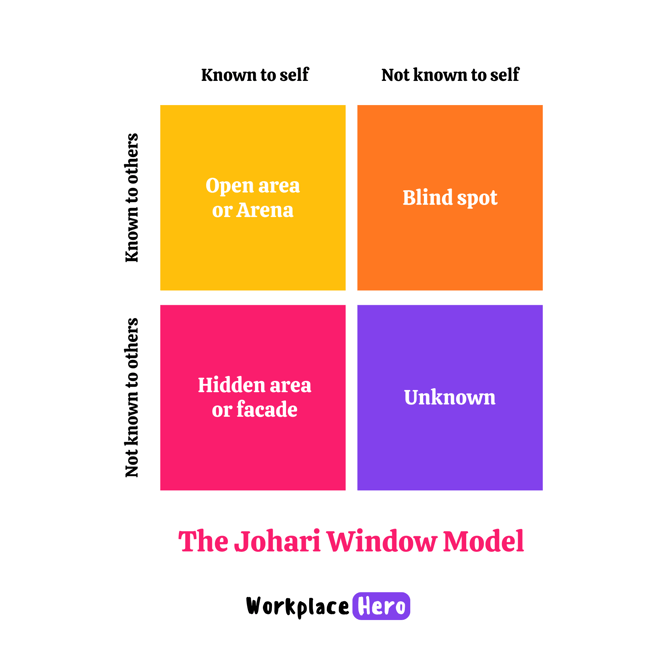
- The Johari Window is a model that represents the four quadrants of self-awareness, helping individuals understand what they know about themselves and what others know about them.
The Four Quadrants (4 minutes)
- Present and explain the four quadrants of the Johari Window:
- Open Area: Known to self and known to others (e.g., personality traits, skills).
- Blind Area: Unknown to self but known to others (e.g., habits or behaviours you're unaware of).
- Hidden Area: Known to self but not disclosed to others (e.g., private thoughts, emotions, or experiences).
- Unknown Area: Unknown to self and unknown to others (e.g., untapped potential, undiscovered talents).
Discussion on Self-Disclosure (4 minutes)
- Emphasise the importance of self-disclosure in expanding the Open Area.
- Encourage the participant to reflect on their own experiences of self-disclosure and how it has affected their relationships.
Practical Application (5 minutes)
- Provide scenarios or examples of situations where the Johari Window concept can be applied.
- Ask the participant to identify aspects of themselves or their communication that may fall into each quadrant.
Feedback and Communication (4 minutes)
- Discuss the role of feedback in the Johari Window model.
- Encourage the participant to seek and provide constructive feedback to expand the Open Area and reduce the Blind and Hidden Areas.
Benefits of Johari Window (2 minutes)
- Highlight the advantages of using the Johari Window, such as improved self-awareness, enhanced communication skills, and strengthened relationships.
Conclusion and Q&A (1 minute)
- Summarise key takeaways from the session.
- Invite the participant to ask any remaining questions or seek clarification on the Johari Window concept.
Feedback and Evaluation (1 minute)
- Collect feedback from the participant regarding the training session, including what they found most valuable and any areas they would like to explore further.
Closing Remarks (1 minute)
- Express appreciation for the participant's engagement and participation.
- Provide contact information for any follow-up questions or assistance.
This 20-minute training session introduces the Johari Window and its relevance to self-awareness and communication. It encourages participants to reflect on their own self-awareness and interpersonal interactions.
1:1 meeting value diagnostic
Do your 1:1s coach people or just collect status updates? Five quick questions.
1. The other person adds items to the agenda before we meet.
2. More time goes on growth and blockers than on status updates.
3. Every 1:1 ends with agreed actions and owners.
4. We start by reviewing actions from last time.
5. 1:1s happen as planned and are rarely cancelled.
Save your learning to Passport
Sign in to save what you've read - we'll create a free CPD log for you.